
The rapid growth AI (AI) as well as machine-learning (ML) within businesses have led to rise of MLOps (Machine Learning Operations) as a specialized discipline. Although the term DevOps (Development Operation) has long been an established standard for software deployment and development, MLOps extends its principles to models for machine learning. Although they share some elements, the two fields have distinct goals and employ different tools and face unique challenges.
This article examines the main distinctions among the two the fundamentals of both workflows, and the ways they are able to contribute to the development of modern AI-driven software and applications.
What is DevOps?
DevOps is a method of software development that blends operations (Dev) and operations (Ops) to streamline the software development lifecycle (SDLC). It is focused on continuous integration and continual delivery (CI/CD) and automation and collaboration between IT and development teams in operations.
The Key features of DevOps
- Automation: Automates integration of code as well as testing and deployment.
- Pipelines for CI/CD: Ensures constant software updates without intervention.
- IaC: Infrastructure as Code (IaC) Enables infrastructure automation and scaling.
- Monitoring and Logging : Monitors the performance of applications and health of the system.
- Collaboration : Bridges the gap between operations and development teams.
Workflow for DevOps
- Project Plan - Define the project's specifications.
- Develop - Write and then integrate code.
- Build & Test - Automate testing for code quality.
- Release & Deploy - Deploy code to production using CI/CD.
- Monitor and Maintain - Ensure that the system is performing and reliability.
What is MLOps?
MLOps (Machine Learning Operations) is an extension of DevOps principles that are specifically designed for model-based learning. It assists in the deployment as well as the monitoring and maintenance of models based on ML for production, making sure they are reliable and accurate in the long run.
The Key Characteristics of MLOps
- Model Training and deployment: Automates the training of ML models and deployment.
- Version Control of Models and Data : Tracks changes in models and data.
- Model Monitoring and Performance Tracking : Make sure that models are solid in the production.
- Scalability : Manages large data sets and computational resources effectively.
- Collaboration : Involves researchers, ML engineers and DevOps teams.
MLOps Workflow
- Data Collection and Preparation - Clean and collect training data.
- Model Training and Evaluation - Create and test models using ML.
- Model deployment - Incorporate models in production systems.
- Model Monitoring and Maintenance - Monitor the performance of your model and then retrain it when necessary.
MLOps vs. DevOps: Key Differences
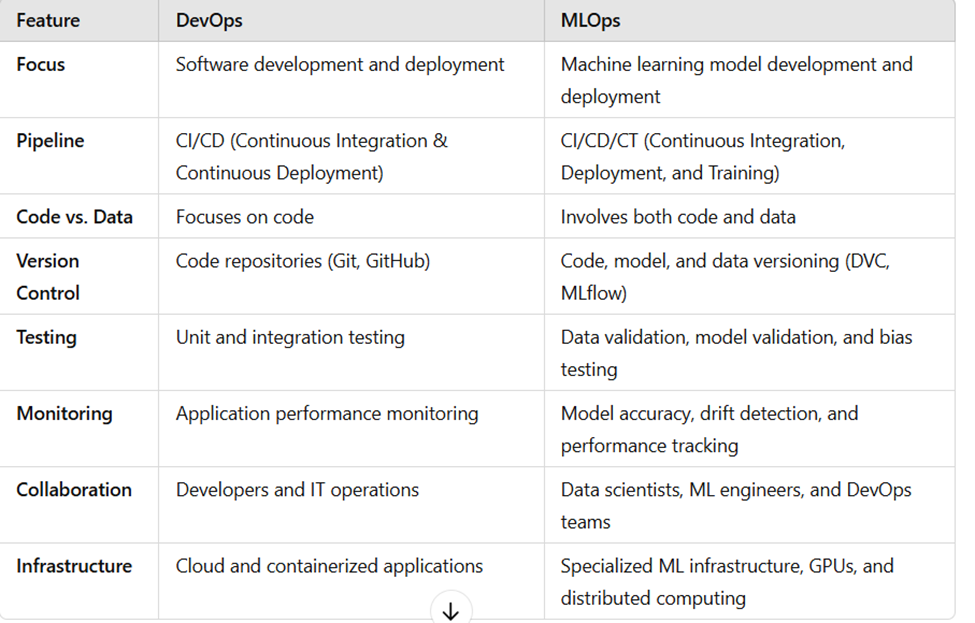
Why MLOps & DevOps Are Both Important
MLOps, on the other hand, is crucial for managing AI driven applications. They both improve automation, scalability and operational efficiency. But they have different purposes. AI solutions are often implemented alongside software applications. DevOps and MLOps are then adopted to create a seamless ecosystem.
Conclusion
DevOps & MLOps are similar in automation & collaboration principles. However, they differ in their scope, workflows, and goals. DevOps simplifies Software Development while MLOps guarantees AI/ML Models remain accurate and reliable during production. Both practices allow businesses to achieve high-efficiency, scalability and innovation for software and AI applications. MLOps Training highlights the key differences between MLOps & DevOps in automation, deployment, and model lifecycle management. To explore these concepts further, you can check out
Machine Learning & AI Certification Courses.
FAQs
1. Can DevOps projects be used to support Machine Learning?
DevOps is insufficient for ML projects, as it does not have model-training, data versioning and monitoring capabilities. MLOps extends DevOps to meet ML specific challenges .
2. What are the most common tools used in MLOps or DevOps today?
· DevOps: Jenkins, Docker, Kubernetes, Terraform, GitHub Actions
· MLOps: MLflow, Kubeflow, DVC, TFX, SageMaker
3. Does MLOps have to be used for all AI projects or just some?
MLOps are not required for simple ML models that have minimal updates. For AI applications that require constant data updates, retraining and scalable AI, MLOps are essential.